
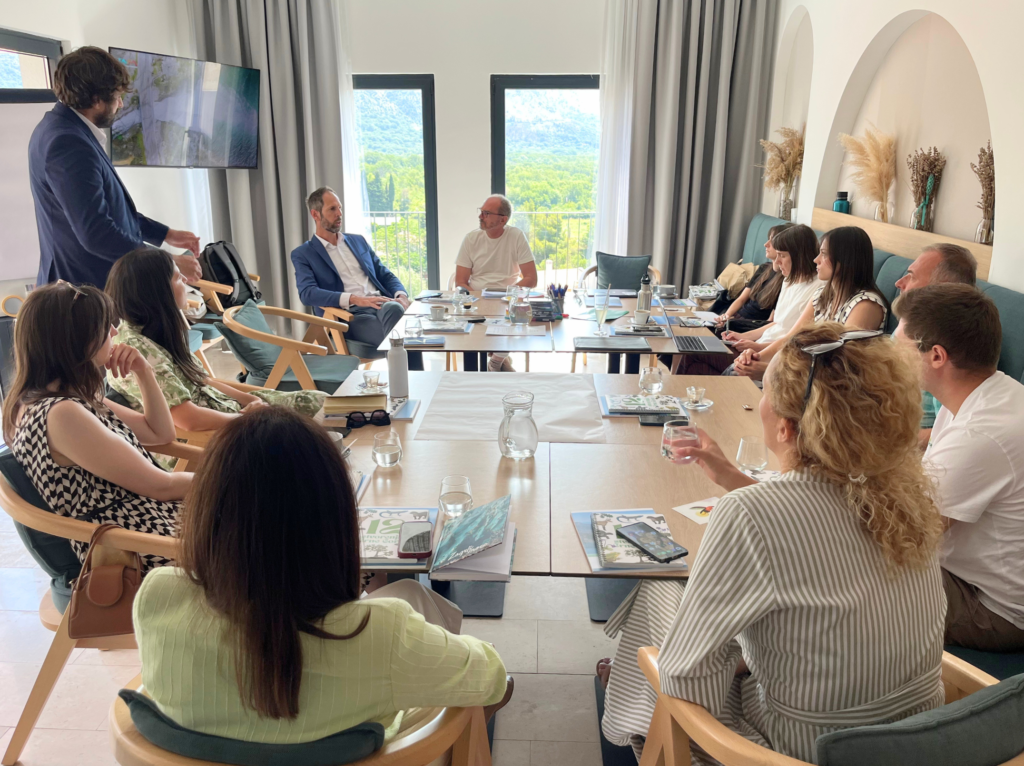
The first meeting of the Buljarica Advisory Board took place in Buljarica on 11 June. The Board was established as part of the project “Together for the Conservation of Buljarica through a Scientific Approach and Community Engagement”, implemented by the Montenegrin Ecologists Society with support from the Critical Ecosystem Partnership Fund (CEPF).
The meeting brought together representatives of institutions, civil society organisations and the local community to jointly explore the challenges, opportunities and possible directions for Buljarica’s future development.
Participants agreed that Buljarica is at a critical and sensitive stage in its development. It is recognised as one of the most valuable natural coastal areas in Montenegro and along the Adriatic, while also being a place shaped by differing expectations, interests and visions for its future.
The meeting identified three key challenges for Buljarica’s future: the lack of a clear development vision and appropriate spatial planning documents; insufficient coordination among institutions involved in development planning and the protection of the area; and limited engagement and involvement of the local community in decision-making. Participants particularly emphasised the need for more transparent planning processes, greater public participation and decisions informed by expert assessments.
One of the central topics of the meeting was Buljarica’s future protection under Natura 2000. Participants emphasised that the area undoubtedly belongs within the Natura 2000 network and that this process represents one of Buljarica’s greatest development opportunities, particularly in terms of sustainable tourism, support for local businesses, access to European funds and improvements to local residents’ quality of life.
Participants particularly emphasised that nature conservation and development should not be viewed as conflicting goals. On the contrary, Buljarica’s preserved natural and cultural heritage was recognised as the foundation for the area’s long-term, sustainable development.
Key development opportunities identified included year-round sustainable tourism, support for local producers and fishers, organic farming, camping, health, educational and scientific tourism, as well as linking the natural and cultural heritage of Buljarica and its hinterland.
The Advisory Board is envisioned as a long-term platform for dialogue and cooperation among institutions, experts, local community representatives and civil society organisations, with the aim of jointly developing solutions for the conservation and sustainable development of Buljarica.
Participants repeatedly highlighted the Municipality of Budva’s key role in Buljarica’s future, given its responsibilities for spatial planning, local development and strategic decisions that will shape the area in the long term. Despite being invited, municipal representatives did not attend the Advisory Board’s first meeting, continuing a pattern of absence from similar initiatives.
Participants agreed that the active involvement of the Municipality of Budva is essential to the success of any future process concerning Buljarica and expressed the expectation that local government representatives would take a more active role in the dialogue on the area’s future.